
Cloud storage will keep expanding, but the more important change is happening around the file itself: who can receive it, how systems move it, where it is processed and what evidence remains afterwards.
The next phase of business file sharing will be less concerned with finding somewhere to place data. Organisations will expect storage, collaboration and external exchange to perform distinct jobs, while still working together as part of one manageable information environment.
The cloud will remain central to this development. It gives organisations flexible capacity, remote access and a practical way to connect distributed teams. Yet a single, undifferentiated cloud environment will not suit every workload. Some information needs long-term storage. Some requires live co-authoring. Other files need to leave the organisation through a controlled transaction and remain available for only a limited period.
Storage and file exchange will become more clearly separated
Mainstream cloud services are well suited to keeping working documents available, synchronising content and supporting collaboration. Sensitive B2B exchange poses different questions. The sender may need to know exactly who received a package, whether it was downloaded and when access should expire.
This does not make general cloud platforms unsuitable or insecure. It reflects a difference in purpose. A permanent project workspace and a time-limited delivery to a supplier should not automatically follow the same process.
What this means for organisations Architecture decisions should begin with the information task: storage, backup, co-authoring, collection, controlled distribution or accountable external exchange.Possession of a link will become a weaker form of authority
Open links remain useful for low-risk information intended for broad circulation. They are harder to justify when a file contains intellectual property, financial records, personal data or confidential technical information.
Future business sharing will rely more heavily on named recipients, multi-factor authentication and centrally managed permissions. Access can then follow the recipient’s role and be changed when a contract ends, an employee leaves or a project moves into a different phase.
The recipient experience still matters. Security controls that are slow or awkward encourage employees and external partners to find alternative routes. Browser-based access, clear notifications and straightforward identity checks can help stronger controls survive everyday deadlines.
The following graphic helps place secure transfer within the wider infrastructure picture. Its value is not the market forecast alone. It shows why external exchange is receiving more attention as cloud use, supply-chain connectivity and governance expectations grow together.
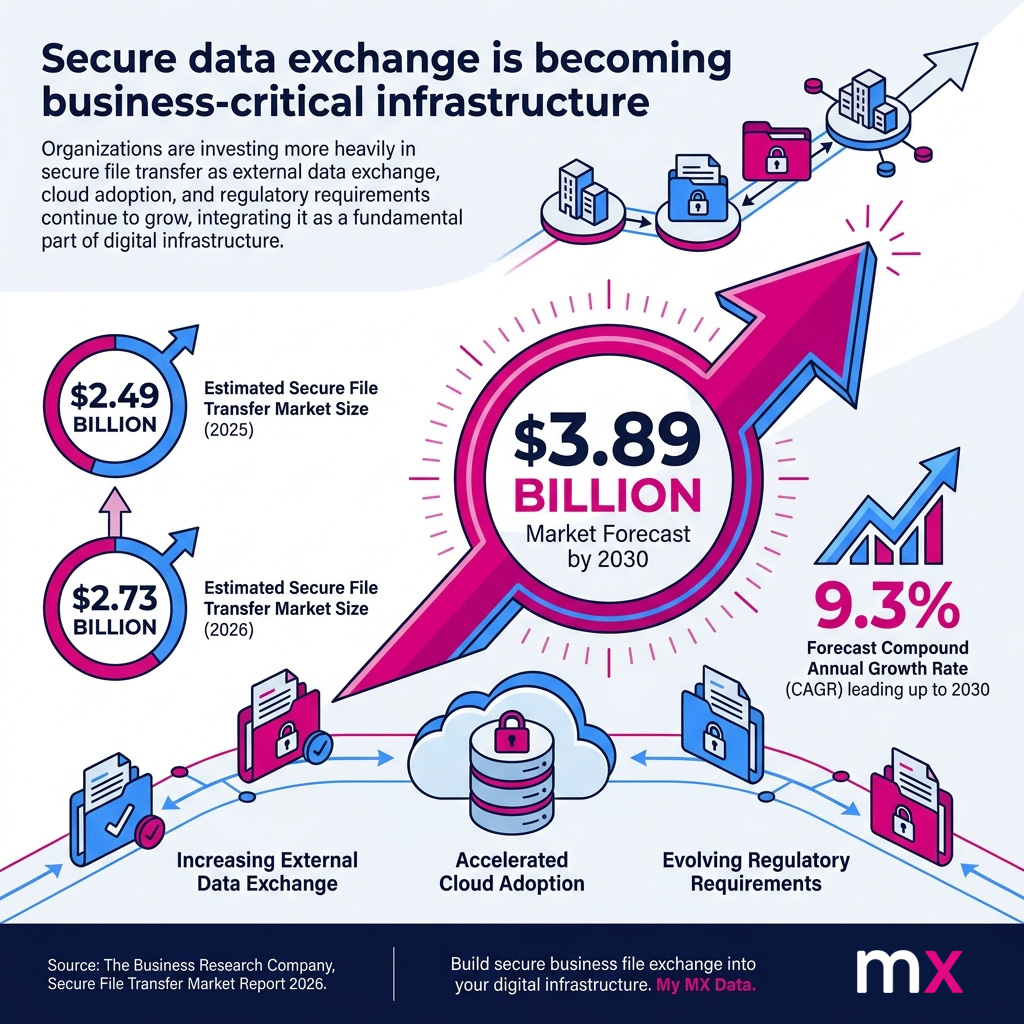
As more information moves between organisations, the handoff requires the same degree of planning as the systems that store and create the files.
Automation will speed up exchanges and make accountability harder
Files are already being generated, classified and routed by connected business systems. AI-assisted tools will increase that activity. They may identify sensitive content, suggest recipients, extract metadata, apply retention rules or flag unusual behaviour.
Those capabilities can reduce repetitive administration, but they can also move information before a person notices an incorrect decision. Organisations will need clear boundaries around which systems can initiate a transfer, which data an AI service can inspect and who remains responsible for approving an external exchange.
The useful standard Automated activity should be as visible as human activity. A later review should show what moved, which rule triggered the action and who authorised the workflow.Data location and portability will influence more buying decisions
Businesses are paying closer attention to where information is stored, which providers can process it and whether data can be moved when commercial or regulatory requirements change. This is particularly relevant to organisations operating across several jurisdictions or working under restrictive customer contracts.
Storage region is only one part of the assessment. Support access, backups, subprocessors and onward transfers may also affect the position. Procurement teams will increasingly ask for precise answers instead of accepting a broad statement that information is held “in the cloud”.
Portability matters for a related reason. A provider should not become the only practical route to the organisation’s own files, activity records or transaction metadata. Export and integration options can reduce dependency and support a more flexible multi-provider strategy.
Three changes will put pressure on existing sharing processes
Pressure Larger and richer filesEngineering models, media packages and complete datasets will make arbitrary attachment limits increasingly disruptive.
Pressure More organisational boundariesCustomers, suppliers, advisers and project partners will need controlled access without becoming internal network users.
Pressure Longer security horizonsOrganisations will consider how long sensitive information must remain protected and how cryptographic methods can be updated.
Security planning will need to include cryptographic change
Encryption will remain a core safeguard, but future procurement will also examine crypto agility. This means the ability to update cryptographic methods without replacing an entire platform or losing access to historical information.
The question is especially relevant for files that must remain confidential for many years. Organisations should understand where encryption is used, how protection is managed and what migration support a provider can offer as standards change.
My MX Data uses AES-256 encryption as part of a wider security model. MX can also provide ASR, which stands for Anonymise, Shard and Restore. ASR makes the underlying information unrecognisable, separates it into protected shards and restores it for an authorised recipient. It is an additional data-protection method, not another name for encryption.
File-sharing platforms will be judged by the evidence they retain
A successful transfer confirms that data arrived. A controlled exchange should reveal more. Administrators may need to see who could access the file, whether it was downloaded, which version was current and how long the information remained available.
This evidence supports investigations, internal reviews and wider compliance work. It does not make an organisation compliant automatically. Policies, lawful processing, staff behaviour, endpoint security and retention decisions remain the customer’s responsibility.
The distinction is covered in more detail in the guide to assessing compliance-supporting file-sharing controls.
The future of file sharing will be measured by how well an organisation can account for information after it has crossed its own boundary.
What should organisations prepare for now?
The useful work is practical. Map the files that regularly leave your organisation. Separate low-risk distribution from exchanges that require named access, expiry, download evidence or specific data-location arrangements. Review where file-size limits and complicated recipient journeys are creating unapproved workarounds.
Identity Can the organisation connect access to an approved recipient rather than possession of a reusable link? Availability Can access expire or be withdrawn when the business purpose, contract or project stage ends? Activity Can administrators see access, downloads, comments and incomplete recipient actions? Location Are storage regions, subprocessors, backups and support arrangements understood? Adaptability Can the service integrate, export information and respond to future security requirements? Usability Can employees, customers and suppliers follow the approved process without unnecessary workarounds?My MX Data is a secure B2B file-exchange platform for organisations that need greater control when information moves between businesses. MX supports named recipients, configurable access, very large transfers and records of exchange activity. It serves a different purpose from permanent cloud storage or live document co-authoring.
For organisations reviewing the gap between their collaboration environment and external delivery process, a controlled B2B file exchange can provide a clearer handoff. The wider MX feature set also supports connected communication, distribution, version awareness and administrative oversight.
Cloud storage will become larger, faster and more distributed. File exchange will become more identity led, automated and accountable. Businesses that prepare now will be in a stronger position to adopt new capabilities without losing sight of who received their important information and what happened next.