
Secure file infrastructure rarely fails because an organisation forgot that encryption matters. The harder problems sit around the transfer itself: who is allowed to send, who can receive, how long access remains open, what happens when a supplier changes staff, and whether anyone can reconstruct the exchange six months later.
For a CTO, file exchange should be treated as an infrastructure capability with defined ownership, controls and evidence. It touches identity, cloud architecture, compliance, user experience and incident response. A mixture of email attachments, public links and department-level tools creates a fragmented control surface.
IdentityNamed, authenticated recipients rather than anonymous access. PolicyConsistent rules for permissions, expiry and sensitive data. EvidenceReliable records of uploads, access, downloads and changes. OperationsA usable service that fits real external workflows. ArchitectureDefine the job before choosing the toolStorage, collaboration and exchange solve different problems
Shared drives and collaboration suites are well suited to storage, synchronisation and live editing. A secure exchange service manages the controlled handoff of information between people or organisations, then records what happened.
That distinction affects architecture. A CTO assessing secure B2B file exchange should look beyond upload and download speeds. The service must show whether the recipient was named and authenticated, whether access can be revoked, which version was downloaded and what administrators can review. These controls matter once files cross company boundaries.
Useful design principleTreat every sensitive external transfer as a transaction with an owner, an intended recipient, a defined availability period and a retained activity record.
Control modelBuild around the whole exchangeEncryption is essential, but it cannot carry the architecture alone
Encryption protects information during storage and transfer. It cannot decide whether access should remain open, identify an incorrect recipient or provide a usable audit record. Those outcomes depend on several controls working together.
01Identity and authentication
Named-user access, multi-factor authentication and, where appropriate, single sign-on help establish who is requesting the file.
02Transaction controls
Permissions, expiry dates, recipient conditions and revocation reduce the period and scope of exposure.
03Audit and oversight
Administrators need usable records of access, downloads, comments, versions and pending activity, not raw logs that nobody reviews.
My MX Data is designed around this exchange-focused control model. MX provides named-recipient access, AES-256 encryption, multi-factor authentication, configurable exchange settings and detailed transaction records. It helps organisations retain control when files move between customers, suppliers, partners and internal teams.
For sensitive material, MX can also use ASR, which stands for Anonymise, Shard and Restore. The data is transformed so its content is not recognisable, separated into protected shards and restored for an authorised recipient. ASR is an additional protection method rather than another label for encryption.
The visual below is useful because it shows where ASR sits within a layered protection approach.
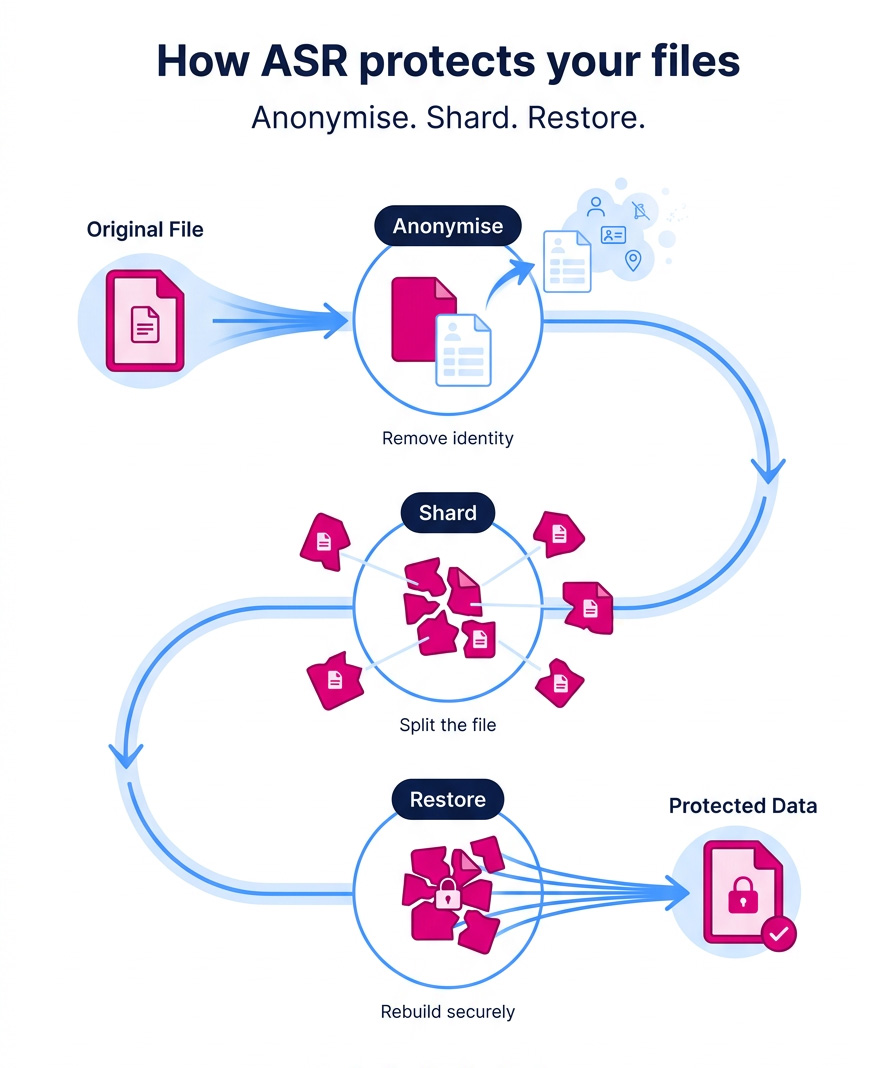
ASR separates protected information before authorised restoration
The complete readable file is not retained as one ordinary object throughout the process.
The vendor review should test behaviour, not just documentation
Questionnaires and certifications provide useful evidence, although they do not show how a service behaves in your workflows. Follow a real transfer from creation to closure.
| Area | Question for the review | Why it matters |
|---|---|---|
| Identity | Can external access be tied to named, authenticated recipients? | Reduces reliance on links that can be forwarded without accountability. |
| Lifecycle | Can access expire, be revoked or be updated without creating a new uncontrolled copy? | Limits long-lived availability and supports changing project conditions. |
| Evidence | Can administrators show who accessed or downloaded a specific version? | Supports investigations, customer queries and wider audit activity. |
| Integration | Can identity, metadata and workflow activity connect with existing enterprise systems? | Prevents the exchange service becoming another isolated administrative task. |
| Resilience | What are the arrangements for availability, recovery, data location and supplier exit? | Keeps file exchange within the organisation’s continuity and third-party risk model. |
Engineering models, media packages and software releases often push teams towards unofficial workarounds. Infrastructure should support real business payloads and provide a practical route to send large files securely without splitting datasets or switching tools.
Operating modelMake the approved route workableAdoption is part of the security design
Employees tend to create workarounds when the approved process is slow, unclear or poorly matched to external users. Recipients should understand what they have received, how to authenticate and what action is expected without lengthy support.
Standardise the common routes. Outbound delivery, inbound collection, distribution and ongoing project exchanges may need different defaults, but they should share one governance model. A controlled file-upload portal, for example, can give external parties a consistent way to submit sensitive material without sending it to a shared inbox.
What good ownership looks like
- Technology teams own architecture, identity integration, resilience and technical configuration.
- Information security and governance teams define control requirements, evidence retention and review activity.
- Business owners identify sensitive workflows, approved recipients and operational exceptions.
- Procurement and legal teams address contracts, data location, supplier assurance and exit arrangements.
Compliance should be framed carefully. Access controls, audit records, encryption and administrative oversight can support wider obligations under data-protection law or an information-security management system. They do not make an organisation compliant by themselves. Policies, lawful processing, staff behaviour, endpoint security, retention and incident response still matter. CTOs working within formal control frameworks may also find the guidance on ISO-aligned file-sharing controls useful when mapping technology to governance requirements.
Decision pointFocus investment where control is weakestStart with the highest-risk handoffs
A full replacement programme may not be the sensible first move. Map transfers involving valuable intellectual property, personal data or regulated records. Find where open links, shared accounts, missing evidence or unclear ownership create the greatest exposure.
From there, define a minimum control standard and test it with real teams. The strongest secure file infrastructure is visible enough to govern, straightforward enough to use and specific enough to show what happened after the file left your organisation.